From state government
to federal justice
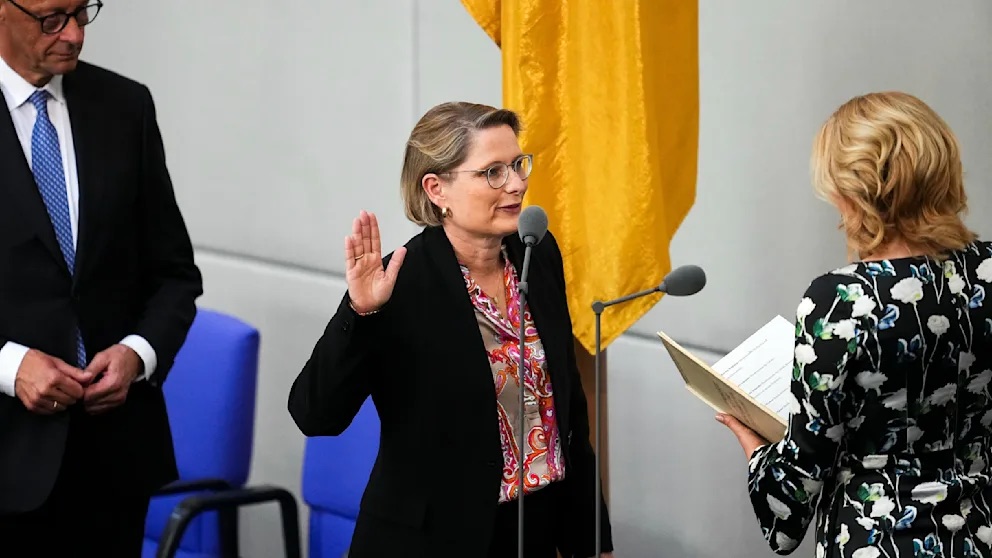
Taking the oath of office in the German Bundestag.
The appointment
On 6 May 2025, after the Bundestag elected Friedrich Merz as Chancellor, Stefanie Hubig was appointed Federal Minister of Justice and Consumer Protection and sworn in before the Bundestag. Under the coalition agreement between CDU/CSU and SPD, the justice ministry went to the SPD. She came directly from the state cabinet of Rhineland-Palatinate, where she had been education minister for nine years, and returned to the ministry in which she had previously served as an official and as State Secretary.
She does not hold a seat in the Bundestag. German federal ministers need not be members of parliament; they are appointed by the Federal President on the proposal of the Chancellor (Article 64 of the Basic Law).
Civil law
The Civil Code: contracts, tenancy, family law, inheritance, liability.
Criminal law
The Criminal Code and the Code of Criminal Procedure.
Procedure
Rules for civil, criminal and administrative courts; court organisation.
Commercial law
Company, insolvency, competition and intellectual-property law.
Consumer protection
Consumer contract law, unfair commercial practices, consumer policy.
Constitutional review
Legal examination of draft laws from all federal ministries.
Federal courts
Appointments process for federal judges; the Federal Public Prosecutor General.
Federal authorities
Including the German Patent and Trade Mark Office and the Federal Office of Justice.
Portfolio summarised from the ministry’s published areas of responsibility. The ministry’s budget (Einzelplan 07) was about €1.21 billion in 2026; the patent office is its main source of revenue.
Why one ministry for both?
Consumer protection is largely private law. The right of withdrawal, unfair contract terms, warranty, product liability and the ban on misleading advertising are all rules of civil or competition law. Placing consumer policy in the justice ministry — as Germany has done since 2013 — puts the protective rules next to the general law they modify.
The combination also reflects a principle: consumer rights are only as strong as the ability to enforce them. Collective redress, small-claims procedures such as the new civil online procedure, and courts with capacity are as much part of consumer policy as the substantive rules themselves.
- 1
Draft bill
The ministry publishes a draft (Referentenentwurf) and consults the Länder, associations and other ministries.
- 2
Cabinet
The federal cabinet adopts the government bill.
- 3
Bundesrat — first pass
The Länder chamber may comment within six weeks; the government replies.
- 4
Bundestag
First reading, committee work (usually the Legal Affairs Committee) with hearings, then second and third readings.
- 5
Bundesrat — second pass
Consent required for some laws; for others the Bundesrat can object or call the mediation committee.
- 6
Signature & promulgation
Countersignature, signature by the Federal President, publication in the Federal Law Gazette.
Example: the law on electronic monitoring in domestic-violence cases was adopted by the cabinet on 19 November 2025, passed by the Bundestag on 8 May 2026 and approved by the Bundesrat on 12 June 2026. Parliamentary Work →
The Bund legislates; the Länder run the courts
Most of German justice is administered by the Länder: they employ judges and prosecutors, finance courts and prisons, and implement federal procedural law. The federal ministry writes much of the law those institutions apply, but cannot hire a single local-court judge. This is why the 2026 Pact for the Rule of Law took the form of federal start-up funding for state posts, negotiated with the Minister-Presidents.
The Conference of Justice Ministers (JuMiKo) of the Länder, which the federal minister attends, and the joint federal–state digital summits are the main forums for this cooperation.
The limits of the office
- Separation of powers (Art. 20(3) Basic Law): legislation is bound by the constitution; the ministry proposes laws but parliament decides.
- Judicial independence (Art. 97): the minister has no authority over judicial decisions.
- Federalism (Arts. 30, 74, 83): procedural and criminal law are areas of concurrent legislation; implementation lies with the Länder.
- Fundamental rights: every investigative or protective measure must be proportionate and can be reviewed by the Federal Constitutional Court.
- EU law: much consumer and data law implements EU directives, within limits set by the Court of Justice of the EU.
Sources
- Federal Government, curriculum vitae and cabinet list — bundesregierung.de
- Federal Ministry of Justice and Consumer Protection, responsibilities of the ministry — bmjv.de
- German Bundestag, budget 2026, Einzelplan 07 — bundestag.de (kw48/2025)
- Basic Law, Articles 20, 30, 64, 74, 76–78, 82, 83, 97 — gesetze-im-internet.de