The Rule
of Law
A constitutional democracy
The rule of law means that public power is bound by law — and that this can be checked by independent courts.
Germany’s Basic Law of 1949 was written in conscious response to the collapse of law under National Socialism. Its first article declares human dignity inviolable and binds all state authority to protect it. Article 20 defines the Federal Republic as a democratic and social federal state and binds legislation to the constitutional order, and the executive and the judiciary to “law and justice”. Article 79(3) — the so-called eternity clause — places these principles beyond the reach of any constitutional amendment.
The German term Rechtsstaat is narrower and broader than the English “rule of law” at the same time: it emphasises the state’s own subjection to law, the separation of powers and comprehensive judicial review of government action.
The eight supporting principles
Basic Law
The constitution ranks above all other law; the Federal Constitutional Court can annul statutes that violate it.
Fundamental rights
Articles 1–19 bind legislature, executive and judiciary as directly applicable law.
Independent courts
Judges are independent and subject only to the law (Art. 97); they cannot be removed against their will except by judicial decision.
Effective judicial protection
Anyone whose rights are violated by public authority has recourse to the courts (Art. 19(4)).
Equality before the law
All persons are equal before the law; discrimination on listed grounds is prohibited (Art. 3).
Legal certainty
Law must be clear, published and generally not retroactive; no punishment without prior law (Art. 103(2)).
Minority protection
Fundamental rights protect individuals and minorities against majorities; the constitution sets limits even to democratic majorities.
Democratic decision-making
Laws are made by elected parliaments, through transparent procedures that allow opposition and public debate.
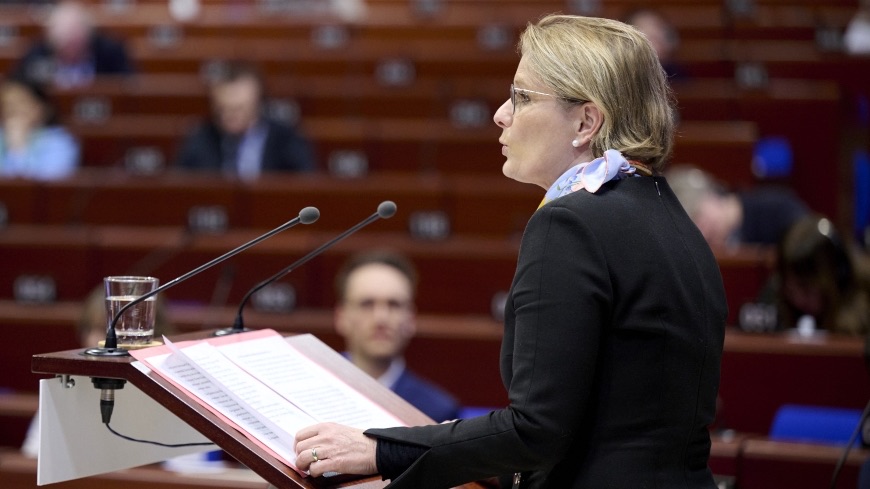
“Everyone must be able to rely on a strong judiciary”
Documented positionWhen Hubig answered questions in the Bundestag’s government Q&A session on 8 July 2026, she began from first principles: Germany is a state under the rule of law, founded on the Basic Law and fundamental rights — a foundation that must be protected and strengthened. Her headline line, as summarised by the Bundestag, was that everyone must be able to rely on a strong judiciary (in German: “Auf eine starke Justiz muss jeder bauen können”).
In a lecture at the Free University of Berlin in January 2026 on the question “Rule of law under pressure?”, she discussed the dismantling of judicial independence in Poland, attacks on candidates for judicial office and threats against judges, and called for citizens who actively defend democracy. In the budget debate of 10 September 2026 she described spending on justice as an investment in the rule of law and in freedom.
AnalysisHer approach treats the rule of law less as a doctrine than as an institution that needs resources: staff, digital infrastructure and procedures that work. This explains why the Pact for the Rule of Law — essentially a staffing and IT programme — is presented as a constitutional project.
Capacity
€450 million federal funding to 2029 for around 2,000 judicial posts and joint justice IT.
IIResilient institutions
Lay judges to be bound to the constitution; proposals against the blocking of judicial elections by extremist parties (announced June 2026).
IIISpeed
Higher local-court threshold, online procedure pilot and a commission on faster criminal trials.
IVEurope
Cooperation with the EU and the Council of Europe on judicial independence and international law.
Where the debate continues
Security versus liberty. Instruments such as IP-address storage are defended as necessary for effective law enforcement and criticised as incompatible with the presumption of liberty. Both sides invoke the rule of law.
Defensive democracy. Proposals to bar people convicted of incitement from standing for office, or to exclude extremists from serving as lay judges, are seen by supporters as democracy protecting itself and by critics, including bar associations, as constitutionally risky.
Federal versus state responsibility. Several Länder argued that temporary federal money leaves them with permanent costs — a reminder that the rule of law is financed mainly by the states.
Transparency. In July 2026 the coalition agreed to restrict requests under the Freedom of Information Act; Hubig said she would examine the draft so that citizens and journalists can continue to obtain information. See Criticism & Controversies.
Sources
- German Bundestag, government Q&A with Federal Minister Hubig, 8 July 2026 — bundestag.de (kw28)
- Freie Universität Berlin, report on the lecture “Rechtsstaat unter Druck?”, 20 January 2026 — jura.fu-berlin.de
- German Bundestag, budget debate Einzelplan 07, 10 September 2026 — bundestag.de (kw37)
- Basic Law, Articles 1, 3, 19, 20, 79, 97, 103 — gesetze-im-internet.de
- LTO and beck-aktuell, reports on lay judges and constitutional loyalty, 15 June 2026