One state, two careers.
Justice administration, 2008–2014
State Chancellery (2008–2009)
Hubig came to Mainz in 2008 as a desk officer in the State Chancellery, responsible for coordinating the state’s justice affairs and for constitutional law. A State Chancellery is the Minister-President’s office: it coordinates the government’s policy across ministries and prepares the state’s votes in the Bundesrat.
Head of the criminal-law department (2009–2014)
From 2009 to 2014 she led the criminal-law department of the Ministry of Justice and Consumer Protection of Rhineland-Palatinate. Under Germany’s federal system, the Länder administer criminal justice: they employ prosecutors, run the prison system and the courts, and shape federal criminal law through the Bundesrat. A state criminal-law department therefore combines legal policy with supervision of the prosecution service.
In 2014 she left for Berlin to become State Secretary at the federal ministry — the same portfolio, now at the federal level.
Education leadership, 2016–2025
Appointment
On 18 May 2016, Minister-President Malu Dreyer appointed Hubig Minister of Education. She was reappointed on 18 May 2021 and continued under Alexander Schweitzer, who succeeded Dreyer in 2024, until her move to the federal cabinet in May 2025.
Portfolio
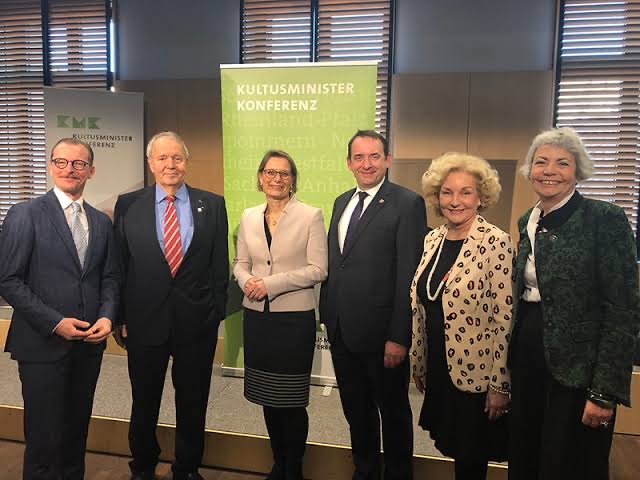
The ministry was responsible for schools, all-day schools, teachers, early-childhood education (Kitas) and language support. During her tenure Rhineland-Palatinate held the presidency of the Standing Conference of Education Ministers (KMK) in 2020, and from 2024 she coordinated the SPD-led education ministries in the KMK.
A full account of her education policy, including its controversies, is on the Education Minister page.
From justice to education — and back
The step from a justice ministry to education looks unusual only at first sight. A State Secretary leads a large administration; a minister of education leads one of the largest of all — in most Länder, teachers form the biggest group of public employees. Administrative leadership, legislative experience and Bundesrat coordination transfer between policy fields.
It was also Hubig’s first political office. Up to 2016 she had held civil-service posts; as minister she answered to the Landtag, defended her policies in public and stood for a party-led government. The nine years in education were, in that sense, the political apprenticeship that preceded the return to justice policy in 2025.
AnalysisThe official sources do not state her reasons for the move in 2016. This page therefore describes the structure of the two posts rather than speculating about motives.
Sources
- Federal Ministry of Justice and Consumer Protection, biography of the Minister — bmjv.de
- Federal Government, curriculum vitae — bundesregierung.de
- Kultusministerkonferenz, “Rheinland-Pfalz übernimmt 2020 KMK-Präsidentschaft” — kmk.org
- Deutscher Bildungsserver, profile of the Rhineland-Palatinate Ministry of Education — bildungsserver.de